Performance
Probatio is pure Python with no native extension. That is a deliberate choice (see ADR-001 and ADR-011): the drop-in promise and easy installation matter more than a native core. Even so, the interpreted engine is well ahead of voluptuous, and a hot schema compiles itself into a specialized validator for more speed. This page explains the cost model and how to measure it, with honest numbers.
The cost model: build once, call cheap
Section titled “The cost model: build once, call cheap”A Schema compiles its definition once, when you construct it. After that, calling
it is the cheap part. So the rule is simple: build the schema once, then reuse it.
from probatio import Schema, All, Coerce, Range
# Built once. Reused for every value.PORT = Schema(All(Coerce(int), Range(min=1, max=65535)))
PORT("443")  # 443PORT(8080)  # 8080
The expensive work (walking the definition, resolving markers, wiring up the validators) happens in the constructor. If you rebuild the schema on every call, you pay that cost every time for nothing.
Two engines: interpreted and compiled
Section titled “Two engines: interpreted and compiled”Validation runs on one interpreted engine. On top of that, a schema can compile itself into a flat function generated for its exact shape, with the per-key work unrolled and the common validators inlined. By default this is automatic: a hot schema compiles itself once it has been called enough to be worth it, and a one-shot schema stays interpreted. Compiling only changes speed; the result is identical, because anything off the happy path bails to the interpreted engine.
You do not have to do anything to get this. To opt a specific schema in eagerly, or to turn the behavior off for an unusual workload, see Compiled schemas.
How it compares to voluptuous
Section titled “How it compares to voluptuous”On the bundled benchmark scenarios, the interpreted engine runs roughly 2.3 to 3.4 times faster than the same schema in voluptuous, and the compiled path lands between 6.7 and 7.4 times faster on the same scenarios. The exact ratio moves with the machine, the Python version, and the shape of the schema, so treat these as ballparks, not promises.
| Scenario | voluptuous | Probatio | Probatio compiled |
|---|---|---|---|
Flat types ({str, int, ...}) | 3.7 µs | 1.1 µs | 0.5 µs |
| Config (coerce, range, in, list) | 6.0 µs | 2.2 µs | 0.9 µs |
| Nested mapping | 7.0 µs | 3.0 µs | 1.0 µs |
Microseconds per validation, lower is faster. Measured July 2026 on one machine with Python 3.13.
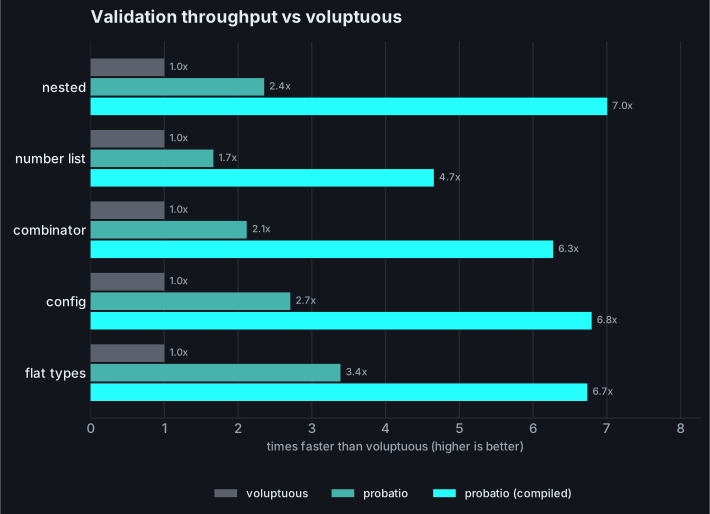
The tracked benchmarks are the CodSpeed ones in bench/test_benchmarks.py. Those
run per pull request, so a performance regression shows up in review. They pin each
case to a known engine (interpreted or compiled) so the two are tracked separately.
The tracked benchmarks live on
CodSpeed, so you can look at the history
yourself.
How a dataclass compares to mashumaro
Section titled “How a dataclass compares to mashumaro”For the dataclass path there is also a comparison against
mashumaro, which generates a from_dict
per class. It is not a like-for-like comparison, and that is the point: mashumaro
deserializes and largely trusts the declared types, while Probatio validates every
field against its type and then constructs. mashumaro does strictly less work, so it
is faster on already-correct input. The compiled Probatio path lands within roughly
1.4x of it on a small dataclass while still validating, and the gap all but closes
as the field count grows (about 1.1x on a wide one).
| Dataclass | mashumaro | Probatio | Probatio compiled |
|---|---|---|---|
| Small (4 fields) | 0.5 µs | 1.5 µs | 0.7 µs |
| Wide (12 fields) | 1.2 µs | 2.8 µs | 1.3 µs |
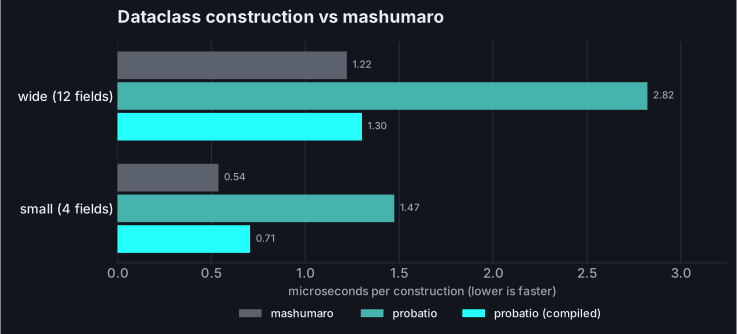
The two libraries pair well: validate untrusted input with Probatio, then hand trusted dataclasses to mashumaro to serialize. See Comparison to alternatives for where each one fits.
How it compares across libraries
Section titled “How it compares across libraries”There is also a cross-library comparison on the dict-to-object path, in the spirit of mashumaro’s benchmark suite: one representative nested record, handed to each library as the same dict, timed turning it into a validated or constructed object.
Be honest about what is being compared, because these libraries do different amounts
of work. Validators (Probatio, pydantic, marshmallow) check every field against
its type and would reject a mismatch; voluptuous validates but returns a dict rather
than constructing an object. Deserializers (mashumaro, cattrs, dacite,
dataclasses-json) build the object and largely trust the declared types. Probatio
appears in both groups: its normal call validates, and its opt-in
construct builds
from trusted input without validating, the same job the deserializers do.
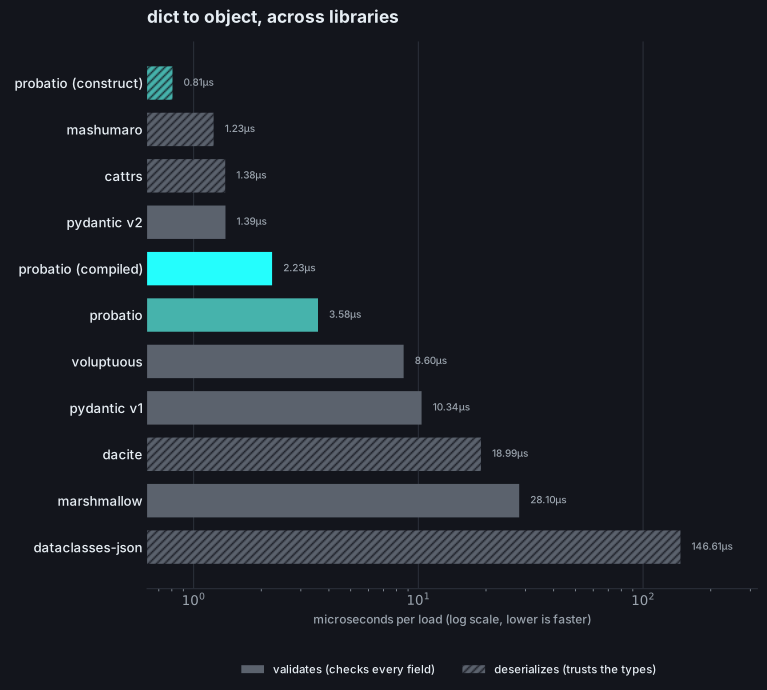
Two honest readings. On the validate path, compiled Probatio lands in the
leading group, ahead of voluptuous, pydantic v1, dacite, marshmallow, and
dataclasses-json, and within about 1.7x of the Rust-cored pydantic v2, while staying
pure Python and validating every field. On the trust the types path,
construct is the fastest in the whole field, ahead of mashumaro and cattrs,
because it is a purpose-built constructor generated for that one dataclass. Run it
yourself with just bench-world.
Narrowing to the like-for-like group, only the libraries that actually validate, makes the placement clearer:
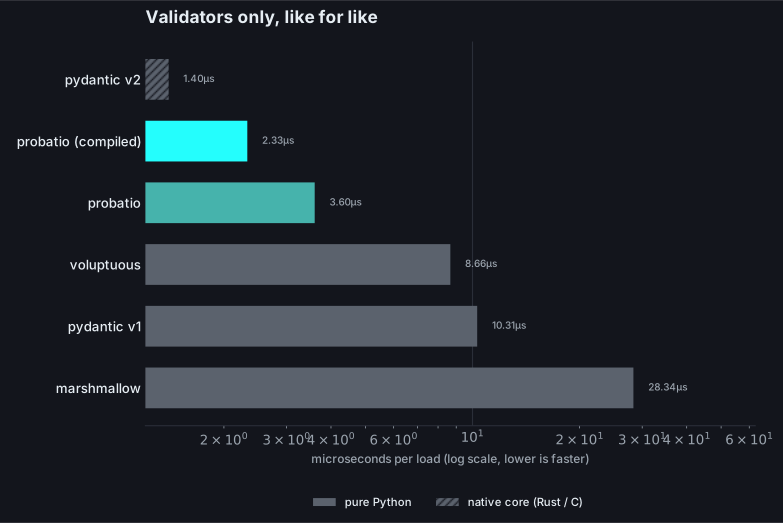
Among validators, the only thing faster than compiled Probatio is pydantic v2, and
it gets there with a native core (the Rust pydantic-core). Probatio is right behind
it and ahead of every other validator, while being pure Python, no extension to
build, nothing to compile at install. That is the trade Probatio is built around:
the speed is close to the native option, the install is a plain pip install.
Measuring it yourself
Section titled “Measuring it yourself”The rough comparison against voluptuous:
just benchThe dataclass comparison against mashumaro:
just bench-dataclassThe cross-library comparison (syncs the extra libraries on first run):
just bench-worldThese print a small table of per-validation times and ratios. Run them a few times;
the absolute numbers wander. The charts on this page are regenerated from the same
data with just charts.
The tracked CodSpeed benchmarks (walltime locally, tracked in CI):
just codspeedThese are not part of the normal test run. They exercise the hot paths interpreted
and compiled: validating a config-style mapping, a dataclass, a nested mapping, a
composed schema, and a combinator under the automatic compile policy; calling a
@probatio-decorated function; compiling a schema from scratch; and the
generation step itself.
To dig into a hot spot, the profiler wraps cProfile (and py-spy) over the generator and the validators it produces:
just profile run-config # see bench/profiling.py for the targetsPractical tips
Section titled “Practical tips”- Build each schema once, at module scope, and reuse it. This is the single biggest win, and it is also what lets a hot schema compile itself.
- Never rebuild a schema inside a hot loop. Compilation is the expensive part.
- Reuse nested schemas too. A
Schemayou reference from another schema is built once and shared. - Let
AUTOdo its job. You rarely need to reach for thecompileflag by hand; the hot schemas speed themselves up. See Compiled schemas for when you do.
Reuse and concurrency
Section titled “Reuse and concurrency”A compiled Schema is meant to be built once and called many times, and that is
also what makes it safe to share. Validating reads the compiled checks and returns
a new value without changing what the schema accepts, so the same Schema instance
can be called from multiple threads at once. The one thing a call can change is the
engine under the hood: a hot schema compiles itself on first use (see
Compiled schemas), and that one-time swap is
synchronized, so two threads racing a cold schema resolve it once and both get the
right result. Build it once at import time and let every worker use it.
The one caveat is your own code. If you write a custom validator that keeps
mutable state, or pass a default factory that is not safe to call concurrently,
that state is yours to make thread-safe. Probatio’s own validators hold no
per-call state.